Deeper Reading Comprehending Challenging Texts Pdf Chapter 1
 Download
Skip this Video
Loading SlideShow in 5 Seconds..
Deeper Reading: Comprehending Challenging Texts, four-12 PowerPoint Presentation


Deeper Reading: Comprehending Challenging Texts, 4-12
Download Presentation
Deeper Reading: Comprehending Challenging Texts, iv-12
- - - - - - - - - - - - - - - - - - - - - - - - - - - Due east N D - - - - - - - - - - - - - - - - - - - - - - - - - - -
Presentation Transcript
-
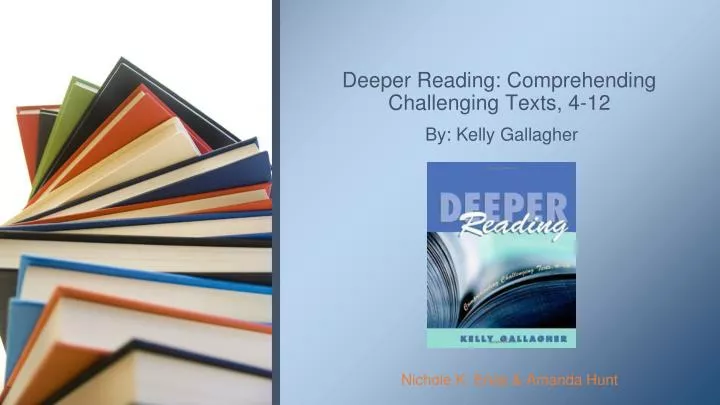
Deeper Reading: Comprehending Challenging Texts, 4-12 By: Kelly Gallagher Nichole K. Enos & Amanda Hunt
-
Why Reading Is Similar Baseball? Baseball game has different levels: • Surface Level - You take a bullpen that throws the ball, concoction that tries to hit the pitch, and if the pitch is hit y'all run to every bit many bases as safely possible. • Deeper Level - Watching for surreptitious signs (Do I have permission to effort to steal 2d base? What blazon of pitch should I throw?), these signs are changed before every pitch, and you may notice players getting nervous as they become aware of another player about to steal base of operations. Your understanding can improve from a surface level to a deeper level as you are taught skills to assist you read. This skill is not acquired spontaneously or randomly, but must be learned.
-
You can assign a reading, give students an assessment, and students pass them. On the surface everything looks fine: Students read the text and can answer the questions. Simply do they really understand what they have read? If yous ask them to evaluate, to clarify, to synthesize, they can't practice it. We want students to be able to read between the lines, nosotros want our students to become readers who tin can move beyond the literal and who can translate the text.
-
Building Scaffolds As teachers we need to provide the instructional scaffolding, the guidance, for our students. An case is if we assign writing instead of teaching students how to write, we'll get poor writing. If we assign reading instead of teaching students how to read, we'll get poor reading.
-
Teaching Challenging Texts
-
Model for Educational activity Challenging Texts
-
Focus Your Reader • Read Through the Text for the Kickoff Time • Re-read the Text to Deepen Comprehension – In any well-crafted text in that location are often layers you do not see on your initial reading. • Interact – The richer the text, the harder information technology is for a unmarried reader to uncover it all on a first reading. It is important that you give your students time to discuss what they discovered while reading.We remember10% of what nosotros read20% of what we hear30% of what we see50% of what we both see and hear70% of what we talk about with others ~Edgar Dale~Collaboration itself raises the reading comprehension of each student in the class, that'southward why it'due south of import for meaningful collaboration time amid students. • Use Metaphor to Deepen Comprehension – An exercise yous can do to introduce metaphors is to explain to your students what "intangible" means. Brainstorm and create a list of intangible items. Ask students if they tin can at present infer what "tangible" means. Create a list. Have students complete the post-obit sentence by selecting on intangible item and on tangible item and then explore the relationship between the ii:(Intangible item)is like a (tangable item) because……An example: Friendship is like a driver's license because it will expire if yous do non renew it. • Lead Students to Meaningful Reflection – Have students reflect on the reading and answer what this book says to them today. It'southward important to get to what the story means to us now.
-
Why should you focus your readers?When you start your motorcar on a freezing morning time, it's all-time to allow it warm upwards for a few minutes before your bulldoze. It is better for the car and provides a smoother ride. This is also true for students when reading an commodity for the outset time or even if they're in the second calendar week of reading a novel. Equally class begins, they are thinking of other things. • Why outset-draft reading?Even students reading at or in a higher place class level often need assist, especially if the text is unfamiliar or circuitous. Telling a student to read a text without giving them whatever other direction or support can produce poor reading. • Why read a 2d fourth dimension?This introduces students to the idea that rich text is layered and that even proficient readers need more than ane reading to help embrace a story. • Why collaborate?Students' thinking improves when they share ideas. • Why use metaphor to deepen comprehension?Metaphor enables readers to: Make much more complex connections when they read; empathise abstract fabric every bit well and equally chop-chop as literal linguistic communication; heighten their thinking processes by encouraging students to seek out associations and connections they would not normally make; and gain insight into relationships amidst ideas that assistance to forge a more thorough understanding of new learning.
-
Focusing the Reader • Cold Reading tin often be a bad idea. Earlier request students to read an unfamiliar and complex text, consider how much meaningful prior noesis they have. The Educational Inquiry Service has published iii types of prior knowledge that are considered important for students as they read content-area texts: (i) Noesis about the topic(2) noesis about the structure and organization of the text(iii) cognition about vocabulary. At that place are two key points according to Sousa that tin can help our students make connections.Central Point1→ If we expect students to find meaning, "we need to be sure that today'due south curriculum contains connections to their past experiences, not just ours."Fundamental Betoken two → "How a person feels near a learning situation determines the corporeality of attention devoted to it." Students demand to intendance almost what they are reading and come across the relevance of the assignment. If they enquire themselves, "What'south in it for me?" they demand to be able to reply it.
-
Six Degree's of Reading What this means is that you follow a path that brings a book into your hands. Something in each book sparks a readers involvement and leads them to a book on a topic they read about in a previous book.An case is maybe yous read a book on The Civil War In this book yous may read about the famous Boxing of Gettysburg that was office of the Ceremonious State of war. So now you'll look into a volume on Gettysburg.When reading about Gettysburg you lot volition hear about General Ulysses S. Grant, so you'll then go out and become a book on him. This is your "Reading Path."
-
Reading Branches When you look upwards a book online at amazon.com yous will become a section that reads, "Customers who bought this book also bought…" Amazon.com understands the importance of prior knowledge when it comes to selling books and it is in this way that Amazon appeals to its customers' reading branches. A reading co-operative shows the types of books a person likes to read. The more than branches you grow, the easier it will be to add new ones. Hither's an example of a Reading Tree and information technology's Reading Branches. Each co-operative shows the different types of books a reader likes: History Sense of humor Mystery Fiction Sci-Fi * Everyone's tree will await dissimilar and accept a different amount of branches. Poetry Teacher Books
-
How to consider what books to teach and which non to teach…. Carol Jago, in Classics in the Classroom (2004, p.47) suggests nosotros choose books that: • Are written in language that is perfectly suited to the author's purpose • Expose readers to complex man dilemmas • Include compelling, disconcerting characters • Explore universal themes that combine different periods and cultures • Challenge readers to reexamine their behavior • Tell a practiced story with places for laughing and places for crying
-
Framing the Text • What you do, or don't practise, before your students read a literary work will determine their level of motivation and interest. • Perils of Assumicide: Assumicide is the decease of a volume that occurs when it is assumed that students possess enough prior knowledge, connections, and motivation to make higher-level reading possible. • Framing Activities to Use Earlier Reading: • Web Searches • Anticipation Guides → These can be used to frame major ideas and themes students volition encounter in the book. • Theme Spotlights → This activity focuses students' attention to ane major theme to study. • Focus Poems → Read thematically related poems beforehand. • K-West-L-R Charts → Before reading have students identify what they know ("K") about the topic. Write downwards everything that is brainstormed, even if it is incorrect (Students will confirm facts through reading or find information that shows what they believed is wrong). Brainstorm what they desire ("W') to know by the time they are done reading the book. Use "L" to list what was learned while reading. "R" is used for questions that were unanswered and will get the ground for post-reading research.
-
Framing Activities to Apply While Reading: • Daily Focus Questions → Text-dependent questions (They crave students to have read the text before they tin answer it) and text-independent questions (Students consider an idea that will aid them ready for what will be found in the reading that day). • The Give-and-take Game → Write a single word on the board and have students explain the significance of that word to the affiliate they read the day before. • Interrupted Summary → Cull a student at random and give them a starter judgement. Afterwards 1-ii sentences interrupt him by calling out another student's proper noun. They option up where the previous pupil left off. This keeps everyone attentive because they don't know who will be called on next to continue the summary. • I Question and One Comment → Students come up to class with one question and i comment generated from their reading assignment. • Word Scramble Prediction → Before reading a climactic affiliate have students predict what will happen. Give them a list of words they volition observe in the chapter they will read and and so give them five minutes to write a prediction of what volition happen in the chapter.
-
Starting time Draft Reading • Educatee anxiety tin can be lowered by telling them that the initial reading of a text is a "commencement-draft" reading. This beginning draft reading can help students go the basics of the text down – familiarizing themselves with the characters, recognizing significant plot points, getting used to the language and structure of the novel. • How can yous help make the first-draft reading equally meaningful as possible? Consider these four key questions: i. Do your students have a reading focus? 2. Are students willing and able to embrace confusion? iii. Can your students monitor their own comprehension? 4. Do your students know fix-it strategies to aid them when their comprehension begins to falter?
-
Ways to create a reading focus: • Help students become an idea of what they are looking for in guild to reduce frustration. Students tin create questions based on the affiliate title or heading. They volition at present exist reading with a purpose, hoping to find the answers to their questions. • The first chapter is usually the most disruptive and a place where a reader can lose focus. Have students generate questions after reading the first chapter. This can teach them to read closely and helps to focus students as they read the residual of the volume. • Place students in groups and provide each group with a specific focus. • Character Charts – This can help continue characters direct. • Shift Charts – Students write adjectives describing the character early in the novel, providing passages from the text with folio numbers as testify. Subsequently the character has undergone change students volition cull a new describing word to describe the character and provide passages that non what caused the modify.
-
How to help students comprehend confusion: • Don't hide your own reading difficulties from students. Permit your struggles exist visible so they can see that reading can be hard for adult readers as well. • Get students to empathize that confusion is natural. • Let students know learning begins when we encounter confusion. How students can monitor their ain comprehension: • When reading a challenging text, students tin oft tell that they are getting lost. They need to take action earlier the situation turns hopeless. • If a educatee says they don't understand a reading, ask them which role they didn't understand. If they say they don't go whatever of it inquire if they understood the commencement word, then if they understood the first sentence, and then the first paragraph. Continue this process with the pupil until yous find where their comprehension begins to pause downwardly. • To help students get an idea of where they are struggling with comprehension, accept them read an extract from an article. Break the article into sections and as they read each section, ask them to score their level of comprehension on a scale of 1 to 10 (one being no understanding, 10 meaning you thoroughly understand). Students then focus on passages that received the lowest scores.
-
How students can monitor their own comprehension continued… • Give students two highlighters. Use ane color to highlight words, phrases, sentences, or entire passages that they sympathise. Employ the other color for everything they don't empathise.Benefits of colour-coding are:1. Provides readers with a focus.2. Motivates readers to concentrate so that they can come up with equally few passages highlighted in the color that means they don't understand.3. It shows the reader where to slow their pace.iv. It alerts readers to the importance of context in trying to make meaning.5. Encourages the reader to revise their comprehension while reading. • Trouble slips → Cut scrap paper into bookmark sized strips. Students employ these to brand notes, flag words and passages that are giving them the hardest time. Students should too use these for their homework.
-
Gear up it strategies to assist students with their comprehension when it falters… • There are two questions to ask: 1. Where exactly do you lot feel you do not understand?2. How many times have you read it? • Search Prefixes/Suffixes/Roots for Partial Meanings → Ex. When asked to define the give-and-take malpractice students know that mal means bad. This helps them to brand an educated guess as to the correct answer. Some other example is the word unenviable. Un ways not, able means able to. Once again, instead of guessing or blindly selecting a selection, students accept a better chance of answering the question correct. • Figure Out Sound-Alikes → Accept the word patricide for case. Very few people are familiar with the word but, they may be familiar with the suffix –cide. Inquire where this suffix has been heard earlier. Words that might come up are: suicide, homicide, and genocide. One time this connection is fabricated, students tin can derive at lease a fractional meaning and make an educated guess to the actual meaning.
-
Second-Draft Reading • On your 2nd read through accept notice of what the text doe not say. Train your students to non but notice what is said but to besides infer what is left unsaid. Students should exist able to look under the surface. This is important considering students are willing to accept whatever they read. They should know that this is a unsafe fashion to read your way through life. "I want them to realize that every fourth dimension something is said, something remains unsaid, and that every time something is written, something remains unwritten." – Kelly GallagherAn example is a tabular array printed in a local paper in California that said: 10 Lowest Orange County API Scores, 2002. The commodity is printed with the schools and their scores. What the tabular array doesn't say is:- The schools have a loftier percentage of not-English language-speaking students.- Students come up and go frequently- Schools are located in low-income neighborhoods.- The schools endure from high absenteeism.- Students come from impress-poor habitation environments.- Many of the students practise not have a quiet place to study at home.None of this data was given with the table that was printed in the paper to assist readers accurately infer as to why the scores were low.
-
Three Key Questions • There are three questions that need to be ask later students have read a text:1. What does it say? Students should be able to support their statements by returning to the text and providing potent textual show.2. What does it mean? 3. What does it matter?Reading literature provides people with a exercise ground to explore problems by asking them, "What does information technology matter?" We help students see the relevance of the great themes institute in classic literature.
-
Strategies to Achieve Deeper Comprehension… • Say/Hateful Chart → This is a t-chart where students are asked on one side to write what the passage says (Literal comprehension) and on the other side what they think the passage ways (Inferential comprehension). • Multi-Layered Time Lines → Develop a fourth dimension line of events. This is peculiarly useful for a novel or play that has an intricate plot or many characters to keep rail of. • Literary Dominoes → Plots of novels, plays, and stories are like dominoes. Ahappens, which causes Bto happen, which in turn causes Cto happen. An example is with the play "Romeo and Juliet." Provide students with the concluding three dominoes in the concatenation. You lot know the play ends in tragedy, but what specific actions lead to this conclusion? Students must identify all the central events in the chain that led to the deaths of Romeo and Juliet. • Flip Side Nautical chart → Every positive has a negative. Everything has a flip side. This tin can help students become disquisitional readers, peculiarly when reading nonfiction.
-
Positive-Negative Chart → A way for students to rail specific literary elements in a novel or play. - Positive vs. negative behavior by the character: Students chart both positive and negative behaviors of the character.- Positive or negative influence other characters have on the chief character: Students pay attention to and chart the influence other characters have on a given graphic symbol. - Highest or lowest indicate in the story: Students mark the loftier and low points of the story for a given grapheme.Positive-negative charting activities work best when students are able to share, discuss, and argue about them. • Reading Symbols → Students write reflections in their reading logs. Some ideas are: Make predictions, recognize when the author uses literary devices, make connections, make judgments, and claiming the text. Afterward writing their reflections students trade logs and expect for evidence of the element. This gives them a double dose of deeper reading reinforcement. • Responsibleness Pie Charts → Students consider which characters or people are most responsible for the book'southward outcome. Ex. Elie Wiesel's "Nighttime," a nonfictional account of the Holocaust. At the end of the unit of measurement students begin diverse people and groups who played a role in the genocide of World War Two. Information technology's like shooting fish in a barrel for students to blame Hitler, but you want them to realize that he needed a lot of aid to murder millions of people. Every bit a form brainstorm all the people and groups who played a role in the Holocaust and students then create a pie chart to visually represent culpability. The higher the pct on the nautical chart, the more than responsible a person is. Students must so defend their charts.
-
The Importance of Collaboration • You can embrace a text the first time you read it, but deeper comprehension is more likely to occur when a reading is discussed with others. An ex. Of how students can hash out a reading is Volume Society. • Collaboration plays an of import role in raising levels of comprehension. • Hitchhiking → Unfortunately, just putting students in groups and giving them time to talk doesn't automatically event in higher-level thinking. Adolescents when given the chance volition ofttimes "hitchhike" in groups which ways they'll go along for the ride and not pay for the gas. Grouping students in a way that encourages meaningful discussion. Here are ii questions to consider for grouping: ane. What atmospheric condition are desirable to help create effective groups?2. Once groups are created which strategies are virtually constructive in creating higher-level thinking.
-
Building Effective Groups • Size Matters → The smaller the size of the groups the better! A practiced number is three because that will encourage participation from everyone in the group. • Ethnicity and Gender → Honor equally many experiences your students bring to the discussion. Y'all want students to hear as many unlike perspectives every bit possible and this can be accomplished past mixing both gender and ethnicity when forming groups. • Time and Task → Students tin be slow to go started. To prompt them to begin immediately, set a time limit! If yous're not certain how long it volition take students to complete a job, try to err on the side of not giving them enough time. You can ever arrange and give them extra time if they are working diligently. Trouble occurs when students have too much fourth dimension to complete the task at mitt. • Specific Roles → Having a role provides each educatee with a focus and gives the grouping a framework. • Accountability → Can be applied to individuals and groups.- Individual Accountability: Each student has to produce a product. Students tin can have the same chore.- Grouping Accountability: Anybody is required to share their group's piece of work and the person selected to stand in front of the class to do so will be chosen at random.
-
Rules to Govern Collaboration • No hitchhiking. Everyone participates. • Be critical of ideas, not people. Disagreement is necessary. • Everyone is in it together, we are a customs of learners. • Recapitulate what someone said if information technology is not clear. • If at that place are two sides to an issue, try to understand both sides. • Heed to everyone's ideas, even if you lot do not agree with them. It ofttimes takes more skill to listen than it does to share. • Permit all ideas emerge.
-
Strategies to promote higher-level thinking in small-group settings • Silent Exchange → Students read a passage or chapter and write a question at the top of the paper. The question has to be open-ended. In groups of v, students pass the papers to one another and have ii minutes to write a response to that question. There is no talking and when the time is upwardly students sign their name and pass the paper to the next person. When the rotation is consummate, each pupil has multiple responses to his or her question. • Save the Last Word for Me → Students re-create a passage they find idea-provoking. The other group members try to guess why the passage was chosen, or they can discuss why it is important. The person who selected the passage gets the last give-and-take. • Trouble Slips → Slips of bookmarked size papers are handed out. Students accept notes of their trouble spots equally they read – places where comprehension falters. In groups students share these spots with peers. • Double-Entry Journals Plus → A t-chart where on the left side is a passage the educatee found compelling and on the right they write a response to the passage. • SOAPS → Much like a literature circle, students are provided with roles to assist them talk over texts.Subject(s): Identifies the discipline and primary idea(s)Occasion: Discusses context of text (Setting, circumstances, events, era, historical or cultural context.Audience: Identifies intended audience and discusses why they were targeted.Purpose: Analyzes author's purpose for composing the piece.Speaker: Determines the tone of vox and why this tone was used.
-
Mystery Envelopes→ Each group gets a "mystery envelop" with an index card with a question for the group to answer. Here are a few examples of some questions: - What lesson(southward) have nosotros learned from a specific character? - This chapter doesn't have a title. What should the championship exist? Why? - Which graphic symbol is most (to the lowest degree) conceivable? Why? • Group "Exams" → Gauge students' understand by having them produce essays or responses to open-ended question. Multiple-choice exams can be useful review tools in group settings to help students prepare for the "real" cess essay. • Group Open Minds → Students are grouped and asked to analyze a graphic symbol using an open mind. They are directed to draw metaphorical representations to illustrate what is going on in the characters caput. If there are multiple characters, each group can take a different character. • Chat Log Exchanges → Logs are provided for each educatee. This method could be used with students in middle schoolhouse and upwardly. Students write anything they want in the log and exercise not sign their names. During second menstruation grade, students pick up the notebookthat corresponds with their number and they write back to the personanonymously. This is repeated over again for third flow class. After the bookis washed students tin can reveal their identity.
-
Using Metaphor to Deepen Comprehension... • By developing your students ability to think metaphorically, you help them to reach deeper levels of comprehension. • Bringing metaphorical thinking into the instructor of literature has two benefits: one. Students are more readily able to reach deeper levels of comprehension when they understand metaphor in challenging text. 2. Repeated practise recognizing and analyzing metaphor enables students to generate their own metaphorical connections to the text and to the world. This in turn can acuminate their higher-level thinking skills. • The OWL (Online Writing Lab) recommends students exist taught the value of metaphorical thinking for three reasons: i. Metaphors enliven ordinary linguistic communication 2. Metaphors crave estimation (Higher-level thinking) 3. Metaphors create new meanings. • Stiff metaphors bring writing live. • Interpreting rich metaphor commonly requires second-draft reading. • Metaphors create new meanings
-
An iceberg is a good metaphor to use when studying a specific character. Similar an iceberg, part of a character is easily visible; but at the aforementioned fourth dimension there might be a part, sometimes a large office, of the character that remains unseen.
-
Metaphorical Graphic Organizers to Analyze Characters • Foursquare Peg, Round Hole → Students should consider both order's expectations on a character (the round hole) and the character's needs (square peg). • Restriction Pedal, Accelerator Pedal → Consider the forces (people, places, things) that slow a character downwardly besides equally the forces that advance a grapheme'south thinking or behavior. • Ingredients Listing → Students listing the character's "ingredients" (traits), with the most important kickoff and the leaset important last. • Archery target → Students make up one's mind how close a graphic symbol came to reaching his or her goal (hitting his or her target). • Wallet/Pocketbook → You can learn a dandy bargain about a person if you were permitted to examine the contents of her bag or the contents of his wallet. Bold the character did have one, what would be in it? What could we larn about a given character from the items establish in that character'southward wallet or purse?
-
Metaphorical Graphic Organizers to Analyze Plot, Structure, and Setting • Pencil, Eraser → A pencil has two ends, one for writing and the other for erasing. On the writing finish of the pencil, students note the actions that grapheme wishes he or she had done. On the eraser end, students consider what actions the grapheme wishes he or she could erase. • Snow Globe → Capture the setting in a five inch sphere. This represents a challenge considering a setting tin can be vast so students demand to pick and chose what they want to incorporate. • Time Capsule → If y'all were to fill a time capsule to give a reader a sense of that time period and place for a specific novel, what would go in information technology? • Backdrop, Props → Carefully consider what you would use as a properties for the staging of a scene.
-
V Considerations... Metaphorical graphic organizes need to be used with careful consideration. To achieve maximum effectiveness, consider the following: • Employ Metaphor to Interpret Metaphor → Brand sure a metaphorical graphic organizer is completed in metaphorical terms. • Don't Turn Graphic Organizers into Worksheets → Use it for a specific complex character, don't utilise it repeatedly for any and all characters. • Keep the "Newness Factor" in Heed When Assigning Metaphorical Graphic Organizers → Don't use the same organizers, create new ones as you go through the schoolhouse year. • Have Students Create and Describe Their Own Metaphorical Graphic Organizers →(Character proper noun) is like a _______________ because __________________________ .This sentence can be worded in multiple different ways:The chain of events in this novel is like a ____________________ because _____________________ .The mood in this novel is like a _________________ because _____________________ .The writing style in this novel is like a _______________________ because ______________________ .The novel is built (put together) like a _________________________ because ______________________ . • Utilize Metaphorical Graphic Organizers as a Springboard to Writing
-
Meaningful Reflections… • Reading is rewarding. • Reading builds a mature vocabulary. • Reading makes yous a better writer. • Reading is hard, and "hard" is necessary. • Reading prepares y'all for the earth of work. • Reading well is financially rewarding. • Reading opens the door to college and across. • Reading artillery you against oppression. • Reading makes you smarter. • Reading develops a moral compass • Mini-lessons are motivational for students to attain reading goals. • When students are aware of the reasons that they should exist a proficient reader, help them to develop positive reading behaviors
-
Students should clarify texts by means of the following… • Label: How does the author develop the characters? What is the difference between "apartment" and "round" characters? Which minor characters play important roles? How do the characters advance the plot and the conflicts? • Time and Sequence: How does the author develop fourth dimension and sequence? Is foreshadowing used? Flashbacks? How does the author craft these time shifts? How exercise these fourth dimension shifts accelerate the telling of the story? • Themes: Which themes emerge from the book? Is there an overriding theme? Do small themes emerge? How are these themes developed? • Author'southward purpose: Why do you lot think the author wrote this volume? What did he or she really desire to say? What was the historical context in which this book was written, and how did this influence the author? Who is/was the author'southward intended audience? • Wording: How does the author's selection of words accelerate the story? Is dialogue used effectively? Does the diction ring true? Does the writer effectively use figurative language—metaphor, simile, and apologue?
-
Symbolism: How does the writer effectively employ symbolism to advance the story? How do these symbols enrich the novel? • Voice: Who is telling the story? Which betoken of view has the author used? How are the other literary elements revealed through the use of narration, dialogue, dramatic monologue, or soliloquy? • Setting: Where is the story set? How does this setting affect the story's evolution? • Conflict: What are the central conflicts in the piece of work? How does the author develop these conflicts? Are the conflicts primarily internal or external? • Irony: How is irony used in the story? What kinds of irony (verbal, situational, dramatic) are used? How does the use of irony advance our agreement of the characters? • Tone: What is the author's attitude in this piece of work? How and where is information technology revealed?
-
Strategies to encourage reflection… Reflection begins with the self. First students think about what this book means for themselves,and and then one time they are aware of the answer, they tin and so dive into the significant of the book itself and reflect upon it in means of others. • Iii degrees of:This strategy incorporates having students think about a central theme within the text and and then suspension that theme up into three degrees in relation to the contemporary world. For example, degrees of Racism. • The most valuable thought:This strategy has students come up with what the nigh valuable idea was from the text.- At the superlative of the paper, students write what they call up is the single most of import thought found in the volume. This thought must be written in a complete sentence.- In the left-hand column, students discover an example in the real earth that illustrates this idea.- In the right-hand column, students explain the connexion between the thought found in the book and the real-world example. three. Theme notebooks 4. Hunt for authors purpose v. Casting Calls - Role play
-
Reading the World Critical Thinking Skills- • Give students more than exposure to a curriculum that, when taught with rigor, provides them with richer opportunities to recollect critically. • Students should exist able to analyze literature in the class, just the bigger goal is that they develop these cerebral skills to a level where they may be transferred beyond the classroom. "Loaded" Language- • Euphemism: the use of a mild or indirect expression instead of 1 that is harsh or unpleasantly direct—from the World Book Dictionary) • Euphemisms can be used by giving students a list of euphemisms and having them think of what the actual word might be • Be sure to hash out and reverberate on the purpose of euphemisms with students • Some other example of "Loaded" Language is how people manipulate words to benefit themselves • This idea of manipulation of language can be taught by using Personal Want Ad's, specifically the dating section. • Discuss with students how someone might manipulate language in a dating ad to make them more interesting or attractive to the reader. For case the word affectionate might really mean needy. Reading Political Cartoons- • Analyzing political cartoons takes a lot of piece of work and thought from students • It is important to conduct a very shut outset read past examining the cartoon and listing everything they meet. (Who, What, When, Where , How) • Afterwards that, asking students deeper questions about the cartoon can exist conducted, such equally, what is the subject field? What is the context? What is the purpose? Who is the audition? What is non said or what is left unsaid in the cartoon? • The adjacent step into deeper reading of political cartoons is to testify opposing cartoons that comprise two opposing views.
-
Cradle-to-Grave Consumerism- • The common goal: to get yous to identify with their brand from an early age so that you develop a sense of nostalgia for the make—nostalgia that will keep you coming dorsum as a lifelong customer. • "Co-ordinate to Eric Schlosser, author of Fast Food Nation, 96 percent of American school children can identify Ronald McDonald, and the Gilded Arches at present have a higher degree of recognition than the Christian cantankerous" • Children brainstorm distinguishing brands during their preschool years. Vi-month-old babies tin recognize corporate logos and mascots. • Brand loyalty begins as early as age two. • The average three-year-old recognizes 100 unlike brand logos. • Toddlers cannot distinguish a commercial from a television evidence. • It isn't until historic period eight that kids begin to realize that advertising can be untruthful and misleading • Explaining this consumerism communication and dialogue to students will allow for them to get enlightened of this propaganda, how it is used and how linguistic communication plays a big office in it. Read All About Information technology- • The younger yous are, the less probable y'all are to read the newspaper • Reading the newspaper is crucial in students reading the earth and preparing for adulthood • Students should become informed members of lodge • 3 Activities to get students interested in reading the newspaper • Its a Wacky World- Detect old newspapers that you take laying around and observe hot topics or events from way back when. Anything interesting, crazy, unbelievable, tragic, happy, that will catch students attention. • Scavenger Hunt- Assist students get an idea and go familiarized with how the paper is sectioned and how to read the newspaper in such ways. • Paper Reading Minute- Spend the commencement infinitesimal of every day (for i month) sharing an interesting newspaper article that the educatee has found. Assign one educatee for each solar day of the month to do then. Challenge students to discover and bring in the MOST interesting article
-
Overall: • Provide students with real earth practice: • Identifying euphemisms • Critically read advertisements • Newspaper Articles • Political Cartoons • Statistics • Brand the time to incorporate Reading the World into the curriculum • It prepares students for college and career readiness and the common core is pushing this concept for students to be prepared and ready for the demands of the earth beyond the classroom.
-
Teaching Deep Reading Questions to consider… • How can we pattern classroom lessons that assist our students attain deeper meaning when they read??? • Without my aid, what will my students take from this reading? • With my assistance, what exercise I want my students to take from this reading? • What can I do to bridge the gap betwixt what my students would learn on their own and what I desire them to learn? • How will I know if my students "got information technology"? Assessment methods: Utilise the backwards design • The assessment should bulldoze the teaching. • When teacher and students know the assessment beforehand, more focused teaching and learning consequence.We should start every unit with a "backwards blueprint" approach in listen (Wiggins and McTighe 1998). *Writing tests subsequently the reading is completed creates a guessing game and should be avoided.
-
What you test is what you get • When because a reading assessment, it helps to remember an acronym coined by Jim Cox, formerly the managing director of assessment in my school commune: WYTIWYG (pronounced "witty-wig"), which stands for "What you exam is what you become." • measure out students thinking through assessments that require deeper thinking, and receive deeper thinking from them • The multiple-choice questions value shallow thinking, then they inspire surface-level thinking. • The essay questions value deeper thinking, and when they are used in assessment, they motility students to a deeper level of comprehension.
-
Dangers! Key thoughts to continue in mind when implementing Deep Reading strategies Danger 1: Overteaching the Book Danger 2: The student becomes over reliant on the teacher
-
How we felt most the book… Pros Cons • Multiple activities are discussed to aid with comprehension. There are also images and charts visually evidence you what is existence discussed at times. • The volume has multiple headings and subheadings that easily help you locate data yous are interested in. • It tin help open your eye's to perspectives yous may not previously take thought of. • Tin help to encourage higher critical thinking with your students through uses of the strategies and activities it discusses. • On Amazon.com the volume is rated 4.9 out of 5 stars (out of 34 votes). You lot tin can read feedback from other teachers that discuss how useful the book was in their classroom. • Repetition → An element may be discussed briefly in a section, only later in the volume it will have an unabridged section to itself. It would be helpful if the two were near each other instead of separate. • Almost all of the activities were well explained, there were occasionally a few that could be hard to understand and may require re-reading.
Source: https://www.slideserve.com/zubeda/deeper-reading-comprehending-challenging-texts-4-12
0 Response to "Deeper Reading Comprehending Challenging Texts Pdf Chapter 1"
Post a Comment