Was There Another Version That Was Rated R of Rosemary's Baby 1968
| Rosemary's Baby | |
|---|---|
 Theatrical release affiche | |
| Directed by | Roman Polanski |
| Screenplay by | Roman Polanski |
| Based on | Rosemary'southward Baby past Ira Levin |
| Produced by | William Castle |
| Starring |
|
| Cinematography | William A. Fraker |
| Edited by |
|
| Music by | Krzysztof Komeda |
| Production | William Castle Enterprises[1] |
| Distributed by | Paramount Pictures |
| Release appointment |
|
| Running time | 136 minutes |
| State | Usa |
| Language | English |
| Upkeep | $3.two million[two] |
| Box role | $33.4 million[2] |
Rosemary's Babe is a 1968 American psychological horror moving picture written and directed past Roman Polanski, and starring Mia Farrow, John Cassavetes, Ruth Gordon, Sidney Blackmer, Maurice Evans, Ralph Bellamy, Angela Dorian, Clay Tanner, and, in his feature film debut, Charles Grodin. The film follows a young, pregnant wife in Manhattan who comes to suspect that her elderly neighbors are members of a Satanic cult, and are grooming her in order to use her baby for their rituals. It is based on the 1967 novel of the same proper noun by Ira Levin.
Though gear up in New York City, the majority of main photography of Rosemary'due south Baby took identify in Los Angeles throughout belatedly 1967. Information technology was released in June 1968 by Paramount Pictures, and was a box-part success, grossing over $30 one thousand thousand in the U.s.a.. The film received numerous accolades, including multiple Gilded Globe Award nominations and two Academy Honour nominations. Ruth Gordon won both the University Award for Best Supporting Actress every bit well equally the Golden Globe in the same category.
Rosemary's Infant deals with themes related to paranoia, women'due south liberation, Christianity (Catholicism), and the occult.[3] The pic earned near universal acclaim from film critics and won numerous nominations and awards. It is widely regarded as ane of the greatest horror movies of all time. In 2014, the pic was selected for preservation in the The states National Film Registry by the Library of Congress, being deemed "culturally, historically, or aesthetically significant."
Plot [edit]
Guy Woodhouse, a stage actor and his wife, Rosemary, move into the Bramford, a big Renaissance Revival apartment building in New York City. They disregard their friend Hutch's warning about the Bramford's nighttime past with witchcraft and murder.
Rosemary meets Terry Gionoffrio, a young recovering drug addict whom Minnie and Roman Castevet, the Woodhouses' elderly neighbors, have taken in. One night, Terry patently jumps to her death from the Castevets' 7th-floor apartment, distressing the Castevets. Guy grows close to them, simply Rosemary finds the couple annoying and meddlesome. Minnie gives Terry's pendant to Rosemary as a proficient luck charm, saying it contains "tannis root".
Guy is bandage in a prominent play afterward the lead role player inexplicably goes bullheaded. With his acting career flourishing, Guy wants to have a baby with Rosemary. On the dark that they plan to excogitate, Minnie brings over individual cups of chocolate mousse for their dessert. When Rosemary complains hers has a chalky "nether-taste" and does not finish information technology, Guy criticizes her as being ungrateful. Rosemary consumes a bit more than to mollify him, and then discreetly discards the rest. Soon afterward, she grows dizzy and passes out. In a dreamlike state, she hallucinates being raped past a demonic presence (Satan) equally Guy, the Castevets, and other Bramford tenants watch. None, including Rosemary, are clothed. The next morning, Guy explains the scratches covering her torso past challenge that he did not want to miss "baby night" and had sexual practice with her while she was passed out.
Rosemary becomes pregnant, due the last calendar week of June. The elated Castevets insist that Rosemary go to their shut friend, Dr. Abraham Sapirstein, a prominent obstetrician, rather than her ain doctor, Dr. Loma. During her beginning trimester, Rosemary suffers severe abdominal pains and loses weight. By Christmastime, her gaunt appearance alarms her friends and also Hutch, who has been researching the Bramford's history. Earlier sharing his findings with Rosemary, he falls into a mysterious blackout. Rosemary, unable to withstand the hurting, insists on seeing Dr. Hill, while Guy argues against it, maxim Dr. Sapirstein volition be offended. As they debate, the pains suddenly stop and Rosemary feels the babe motion.
Three months later, Hutch's friend, Grace Cardiff, informs Rosemary that Hutch is expressionless. Before dying, he briefly regained consciousness and said to requite Rosemary a book on witchcraft, All of Them Witches, along with the cryptic message: "The name is an anagram". Rosemary somewhen deduces that Roman Castevet is an anagram for Steven Marcato, the son of a former Bramford resident and a reputed Satanist. She suspects that the Castevets and Dr. Sapirstein belong to a Satanic coven and accept sinister intentions for her baby. Guy discounts this and afterwards throws the book away, upsetting Rosemary and making her suspicious of him.
Terrified, she goes to Dr. Hill for help. Assuming that she is delusional, he calls Dr. Sapirstein, who arrives with Guy to take her dwelling house. Rosemary locks herself into the apartment, but coven members somehow infiltrate and restrain her. Dr. Sapirstein sedates a hysterical Rosemary, who goes into labor and gives birth. When she awakens, she is told that the baby was stillborn. Equally Rosemary recovers, she notices her pumped breast milk appears to be saved instead of disposed of. She stops taking her prescribed pills, becoming less groggy. Afterwards Rosemary hears an infant crying, Guy mentions that new tenants with a baby accept moved into the building.
Believing her infant is alive, Rosemary discovers a hidden door leading into Minnie and Roman's apartment. The Castevets, Guy, Dr. Sapirstein, and other coven members are gathered effectually a bassinet draped in black with an upside downwards cross hanging over it. Peering within, Rosemary is horrified and demands to know what is wrong with her baby'south eyes. Roman proclaims that the child is Adrian, Satan's son. He urges Rosemary to female parent her child, promising her that she will non have to join the coven. When Guy attempts to calm her, saying that they will be rewarded and can excogitate their own kid, she spits in his confront. After hearing the infant's cries, however, Rosemary gives in to her maternal instincts and gently rocks the cradle.
Cast [edit]
- Mia Farrow as Rosemary Woodhouse
- John Cassavetes every bit Guy Woodhouse
- Ruth Gordon as Minnie Castevet
- Sidney Blackmer as Steven Marcato / Roman Castevet
- Maurice Evans as Hutch
- Ralph Bellamy as Dr. Abraham Sapirstein
- Charles Grodin equally Dr. Hill
- Patsy Kelly as Laura-Louise McBirney
- Angela Dorian as Terry Gionoffrio
- Elisha Melt as Mr. Nicklas
- Emmaline Henry as Elise Dunstan
- Hanna Landy as Grace Cardiff
- Philip Leeds as Dr. Shand
- Hope Summers as Mrs. Gilmore
- D'Urville Martin as Diego
- Tony Curtis as Donald Baumgart
- Marianne Gordon as Rosemary's Girlfriend
- Wendy Wagner every bit Rosemary's Girlfriend
- Fritzi Jane Courtney as woman at party
- Dirt Tanner as the Devil
Product [edit]
Evolution [edit]
In Rosemary's Baby: A Retrospective, a featurette on the DVD release of the film, screenwriter/director Roman Polanski, Paramount Pictures executive Robert Evans, and production designer Richard Sylbert reminisce at length about the production. Evans recalled William Castle brought him the galley proofs of the book and asked him to buy the motion picture rights even before Random House published the book in April 1967. The studio caput recognized the commercial potential of the projection and agreed with the stipulation that Castle, who had a reputation for depression-budget horror films, could produce just not direct the film adaptation. He makes a cameo appearance as the human at the telephone booth waiting for Mia Farrow to finish her call.
François Truffaut claimed that Alfred Hitchcock was offset offered the chance to directly the film but declined.[1] Evans admired Polanski'southward European films and hoped he could convince him to make his American debut with Rosemary'south Baby.[4] He knew the manager was a ski buff who was broken-hearted to brand a movie with the sport as its basis, and so he sent him the script for Downhill Racer along with the galleys for Rosemary's Babe.[5] Polanski read the latter book non-stop through the night and called Evans the following morning to tell him he thought Rosemary'due south Baby was the more interesting project, and would like the opportunity to write as well as direct it.[6] Later on negotiations, Paramount agreed to hire Polanski for the project, with a tentative budget of $1.nine million, $150,000 of which would get to Polanski.[half dozen]
Polanski completed the 272-page screenplay for the film in approximately 3 weeks.[six] Polanski closely modeled it on the original novel and incorporated large sections of the novel's dialogue and details, with much of it being lifted straight from the source text.[7]
Casting [edit]
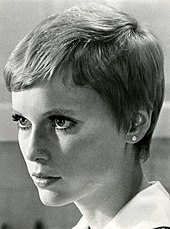
Mia Farrow received widespread praise for her performance as Rosemary Woodhouse
Casting for Rosemary'south Baby began in the summer of 1967 in Los Angeles, California.[8] Polanski originally envisioned Rosemary as a robust, total-figured, daughter-next-door type, and wanted Tuesday Weld or his own fiancée Sharon Tate to play the role.[8] Additionally, Jane Fonda, Patty Duke and Goldie Hawn were considered for the part.[8] [9]
Since the book had non yet reached bestseller status, Evans was unsure the title lonely would guarantee an audition for the film, and he believed that a bigger name was needed for the atomic number 82. Mia Farrow, with a supporting part in Guns at Batasi (1964) and the yet-unreleased A Cracking in Aspic (1968) every bit her only feature moving-picture show credits, had an unproven box office track record; however, she had gained wider find with her role as Allison MacKenzie in the popular idiot box series Peyton Identify, and her unexpected matrimony to noted singer Frank Sinatra.[ten] Despite her waif-like appearance, Polanski agreed to cast her.[10] Her credence incensed Sinatra, who had demanded she forgo her career when they wednesday.[11]
Robert Redford was the commencement selection for the function of Guy Woodhouse, but he turned information technology down.[12] Jack Nicholson was considered briefly before Polanski suggested John Cassavetes, whom he had met in London.[12] In casting the moving-picture show's secondary actors, Polanski drew sketches of what he imagined the characters would wait similar, which were then used by Paramount casting directors to match with potential actors.[13] In the roles of Roman and Minnie Castevet, Polanski cast phase actors Sidney Blackmer and Ruth Gordon, respectively.[13] Ralph Bellamy, also primarily a stage actor, was cast in the role of Dr. Abraham Sapirstein.[xiii]
Polanski wanted to cast Hollywood quondam-timers every bit the coven members simply did non know any past proper name. He drew sketches of how he envisioned each graphic symbol, and these helped the casting manager fill up the roles. In every instance, the thespian cast strongly resembled Polanski's cartoon. They included Ralph Bellamy, Patsy Kelly, Elisha Cook, Jr., Phil Leeds and Promise Summers.[ citation needed ]
When Rosemary calls Donald Baumgart, the actor who goes blind and is replaced by Guy, the voice heard on the telephone is role player Tony Curtis. Farrow, who had non been told who would be reading Baumgart's lines, recognized his voice but could not place it. The slight confusion she displays throughout the telephone call was exactly what Polanski hoped to capture by not revealing Curtis' identity in advance.[ citation needed ]
Filming [edit]

The Dakota served as a stand-in for outside shots of the fictional Bramford Edifice
Principal photography for Rosemary'due south Babe began on August 21, 1967, in New York City, where location shooting commenced.[1] When Farrow was reluctant to motion picture a scene that depicted a mazed and preoccupied Rosemary wandering into the middle of 5th Avenue into oncoming traffic, Polanski pointed to her pregnancy padding and reassured her, "no one'southward going to hit a pregnant adult female". The scene was successfully shot with Farrow walking into real traffic and Polanski following, operating the manus-held photographic camera since he was the just one willing to practice information technology.[1] [14]
By September 1967, the shoot had relocated to California's Paramount Studios in Hollywood, where interior sets of the Bramford apartments had been synthetic on soundstages.[i] Some additional location shooting took place in Playa del Rey in October 1967.[one] Farrow recalled that the dream sequence in which her character is attending a dinner party on a yacht was filmed on a vessel virtually Santa Catalina Island.[15] Though Paramount had initially agreed to spend $i.9 million to make the film, the shoot was overextended due to Polanski's meticulous attending to item, which resulted in him completing upwardly to l takes of single shots.[16] The shoot suffered meaning scheduling issues every bit a outcome, and ultimately went $400,000 over budget.[17] In November 1967, it was reported that the shoot was over three weeks behind schedule.[ane]
The shoot was further disrupted when, midway through filming, Farrow's husband, Frank Sinatra, served her divorce papers via a corporate lawyer in front of the cast and crew.[16] In an effort to salvage her relationship, Farrow asked Evans to release her from her contract, but he persuaded her to remain with the project after showing her an hour-long crude cut and assuring her she would receive an University Award nomination for her performance.[18] Filming was completed on Dec 20, 1967, in Los Angeles.[ane]
Music [edit]
The lullaby played over the intro is the vocal "Sleep Safe and Warm." Information technology was composed by Krzysztof Komeda and sung by Mia Farrow.[xix] The song "Für Elise" is likewise frequently used every bit groundwork music throughout the film. The original film soundtrack was released in 1968 via Dot Records. Waxwork Records released the soundtrack from the original chief tapes in 2014 which included Krzysztof Komeda's original work.[20]
Release [edit]
Critical response [edit]
In gimmicky reviews, Renata Adler wrote in The New York Times that "The moving-picture show—although information technology is pleasant—doesn't seem to work on any of its dark or powerful terms. I think this is because it is well-nigh also extremely plausible. The quality of the young people's lives seems the quality of lives that i knows, even to the point of finding quondam people side by side door to avert and lean on. 1 gets very annoyed that they don't catch on sooner."[21]
Variety said, "Several exhilarating milestones are achieved in Rosemary's Babe, an excellent picture show version of Ira Levin'due south diabolical chiller novel. Writer-director Roman Polanski has triumphed in his offset US-fabricated pic. The flick holds attention without explicit violence or gore... Farrow'due south performance is outstanding."[22]
The Monthly Film Bulletin said that "After the miscalculations of Cul de Sac and Dance of the Vampires", Polanski had "returned to the rich vein of Repulsion".[23] The review noted that "Polanski shows an increasing ability to evoke menace and sheer terror in familiar routines (cooking and telephoning, particularly)," and Polanski has shown "his transformation of a cleverly calculated thriller into a serious work of art."[24]
Today, the film is widely regarded as a classic; information technology has an approval rating of 96% on review aggregator website Rotten Tomatoes based on 72 reviews, with an average rating of 8.lxxx/x. The site'due south critics' consensus describes it as "A frightening tale of Satanism and pregnancy that is even more disturbing than it sounds thanks to convincing and committed performances by Mia Farrow and Ruth Gordon."[25] Metacritic reports a weighted average score of 96 out of 100 based on fifteen critics, indicating "universal acclaim".[26]
Accolades [edit]
Home media [edit]
The Rosemary's Infant DVD, released in 2000 by Paramount Home Video, contains a 23-minute documentary film, Mia and Roman, directed by Shahrokh Hatami, which was shot during the making of the movie. The title refers to Mia Farrow and Roman Polanski. The motion picture features footage of Roman Polanski directing the film'due south cast on set. Hatami was an Iranian photographer who befriended Polanski and his married woman Sharon Tate.[27] Mia and Roman was screened originally as a promo film at Hollywood's Lytton Center,[28] and after included equally a featurette on the Rosemary's Baby DVD. It is described as a "trippy on-set featurette"[29] and "an odd piffling bit of cheese."[30]
On October 30, 2012, The Criterion Drove released the film for the showtime time on Blu-ray.[31]
Legacy [edit]
Following the film's premiere, a string of other films focusing on Satan worshippers and blackness magic were produced, including The Brotherhood of Satan, Mark of the Devil, Black Noon, and The Blood on Satan'due south Hook.
The scene in which Rosemary is raped by Satan was ranked No. 23 on Bravo'southward The 100 Scariest Flick Moments.[32] In 2010, The Guardian ranked the flick the 2d-greatest horror picture show of all time.[33] In 2014, it was accounted "culturally, historically, or aesthetically meaning" past the Library of Congress and selected for preservation in the National Motion-picture show Registry.[34]
Sequels and remakes [edit]
In the 1976 television film Look What's Happened to Rosemary'south Baby, Patty Knuckles starred every bit Rosemary Woodhouse and Ruth Gordon reprised her role of Minnie Castevet. The film introduced an developed Andrew/Adrian attempting to earn his place as the Antichrist. It was disliked equally a sequel by critics and viewers, and its reputation deteriorated over the years. The picture show is unrelated to the novel's sequel, Son of Rosemary.[35]
A remake of Rosemary'south Infant was briefly considered in 2008. The intended producers were Michael Bay, Andrew Form, and Brad Fuller.[36] The remake fell through subsequently that same year.[37]
In January 2014, NBC made a four-hour Rosemary'due south Babe miniseries with Zoe Saldana as Rosemary. The miniseries was filmed in Paris under the direction of Agnieszka Holland.[38]
In 2016, the movie was unofficially remade in Turkey nether the title Alamet-i-Kiyamet.[39]
The brusque "Her Only Living Son" from the 2017 horror album picture XX serves equally an unofficial sequel to the story.[40]
In popular culture [edit]
The film inspired the English language band Deep Purple to write the song "Why Didn't Rosemary?" for their third anthology in 1969, after the band had watched the movie while touring the US in 1968. The vocal'south lyrics pose the question, "Why didn't Rosemary e'er have the pill?"[41]
The movie was parodied in the 1996 Halloween episode of Roseanne, "Satan, Darling".[42]
See as well [edit]
- Listing of American films of 1968
- Satanic film
- Anton LaVey
Notes [edit]
- ^ Tied with Barbra Streisand for Funny Daughter.
References [edit]
- ^ a b c d e f k h "Rosemary's Infant". AFI Catalog of Feature Films. American Picture show Institute. Archived from the original on August 7, 2020. Retrieved December 23, 2020.
- ^ a b "Rosemary'south Babe, Box Part Information". The Numbers. Archived from the original on September ten, 2013. Retrieved Dec 23, 2020.
- ^ Ward, Sarah (2016). "All of them witches: Individuality, conformity and the occult on screen". Screen Education (83): 34–41. Archived from the original on June 25, 2021.
- ^ Sandford 2009, pp. 109–110.
- ^ Sandford 2009, p. 109.
- ^ a b c Sandford 2009, p. 110.
- ^ Vlastelica, Ryan (November 3, 2016). "In adapting Rosemary's Baby, Polanski traded ambiguity for dreadfully inevitable horror". The A.Five. Social club. Archived from the original on May 1, 2020. Retrieved December 24, 2020.
- ^ a b c Sandford 2009, p. 111.
- ^ "The roles that got away". Fox News. 26 May 2015.
- ^ a b Sandford 2009, pp. 111–115.
- ^ Sandford 2009, p. 114.
- ^ a b Sandford 2009, p. 112.
- ^ a b c Sandford 2009, p. 113.
- ^ Stafford, Jeff. "Rosemary's Infant". Turner Archetype Movies. Archived from the original on September thirteen, 2012. Retrieved February 28, 2009.
- ^ Remembering Rosemary's Baby 2012, 29:00.
- ^ a b Sandford 2009, p. 115.
- ^ Sandford 2009, pp. 114–115.
- ^ Sandford 2009, pp. 115–116.
- ^ "Rosemary's Baby: The Devil Was Not But in the Details". Culture.pl. Archived from the original on 28 October 2018. Retrieved 27 Oct 2018.
- ^ Turek, Ryan (December 5, 2013). "Sectional Await at Waxworks Records' Rosemary'southward Baby Vinyl, Art Past Jay Shaw!". ComingSoon.net. Archived from the original on September xx, 2020. Retrieved August v, 2020.
- ^ Adler, Renata (June 13, 1968). "The Screen: 'Rosemary'due south Baby,' a Story of Fantasy and Horror; John Cassavetes Stars With Mia Farrow". The New York Times. Archived from the original on January 6, 2021. Retrieved December 24, 2020.
- ^ "Rosemary'southward Babe". Variety. January 1968. Archived from the original on February 26, 2021. Retrieved December 24, 2020.
- ^ Christie 1969, p. 95.
- ^ Christie 1969, p. 96.
- ^ "Rosemary's Baby (1968)". Rotten Tomatoes. Archived from the original on December seven, 2020. Retrieved May 1, 2021.
- ^ "Rosemary's Babe". Metacritic. Archived from the original on November 12, 2020. Retrieved June 4, 2019.
- ^ "Shahrokh Hatami". Archived from the original on 2018-09-24. Retrieved 2018-09-24 .
- ^ "Checking Rumors on a 'Wild Bunch'". Los Angeles Times. July 9, 1968. p. E11.
- ^ Harris, Mark (Oct 27, 2000). "DVD Review: Rosemary'southward Babe: Collector'south Edition". Entertainment Weekly. Archived from the original on November 17, 2020. Retrieved Dec 24, 2020.
- ^ "Polanski balances terror, humor the manager adds cant upon deceit in Rosemary's Baby until we finally find the truth". Orlando Sentinel. Oct 20, 2000. p. 42.
- ^ "Rosemary'southward Baby Blu-ray". Blu-ray.com. Archived from the original on December xix, 2015.
- ^ "The 100 Scariest Movie Moments". Bravo. Archived from the original on October 30, 2007.
- ^ Billson, Anne (October 22, 2010). "Rosemary's Baby: No 2 best horror pic of all fourth dimension". TheGuardian.com. Archived from the original on August 24, 2013. Retrieved December 24, 2020.
- ^ Cannady, Sheryl (Dec 17, 2014). "Cinematic Treasures Named to National Film Registry" (News release). Library of Congress. Archived from the original on December 25, 2020. Retrieved December 29, 2017.
- ^ Mankiewicz, Ben. "Look What's Happened To Rosemary's Babe (1976)". Turner Archetype Movies. Archived from the original on March 21, 2019. Retrieved March 21, 2019.
- ^ "Rosemary'south Baby Remake Confirmed". Movie theatre alloy. 12 March 2008. Archived from the original on June v, 2021. Retrieved May 21, 2010.
- ^ Rosemary's Baby Remake Scrapped, IMDb, 22 December 2008, archived from the original on 17 May 2018, retrieved 30 June 2018 .
- ^ Andreeva, Nellie (8 Jan 2014). "Zoe Saldana To Topline NBC Miniseries 'Rosemary's Infant'". Deadline. Archived from the original on 27 March 2014. Retrieved 14 November 2019.
- ^ "Alamet-i-Kiyamet". Filmaffinity. Apr 17, 2021. Archived from the original on April 17, 2021. Retrieved April 17, 2021. .
- ^ "Archived re-create". Archived from the original on 2020-08-06. Retrieved 2020-05-18 .
{{cite web}}: CS1 maint: archived copy as title (link) - ^ "Derek Lawrence Interview". Deep-Purple.internet. May 2003. Retrieved 7 January 2014.
- ^ "ROSEANNE: SATAN, DARLING (Television)". www.paleycenter.org. The Paley Centre for Media. Retrieved 11 January 2022.
Sources [edit]
- Christie, Ian Leslie (1969). "Rosemary's Baby". Monthly Motion picture Message. Vol. 36, no. 420. London: British Picture Plant. ISSN 0027-0407.
- Remembering Rosemary's Baby (Documentary short). The Criterion Collection. 2012.
- Sandford, Christopher (2009). Polanski: A Biography. New York Urban center, New York: Macmillan. ISBN978-0-23-061176-4.
External links [edit]
- Rosemary's Baby at the American Film Establish Itemize
- Rosemary'due south Infant at AllMovie
- Rosemary's Baby at IMDb
- Rosemary's Babe at Metacritic
- Rosemary'due south Baby at Rotten Tomatoes
- Rosemary's Baby at the TCM Moving picture Database
- Dialogue Transcript, Script-o-rama .
- "William Castle's involvement in the motion picture", Faber & Faber, Film in focus, archived from the original on 2008-08-29, retrieved 2008-07-28 .
- The many faces of Rosemary's baby, PL: Culture . Collection of Rosemary's Baby posters from effectually the world.
- BABY, podcast by Civilisation.pl'due south Stories From The Eastern W about the making of the picture show.
- Rosemary's Baby: "It's Alive" an essay by Ed Park at the Criterion Collection
Source: https://en.wikipedia.org/wiki/Rosemary%27s_Baby_(film)
0 Response to "Was There Another Version That Was Rated R of Rosemary's Baby 1968"
Post a Comment